
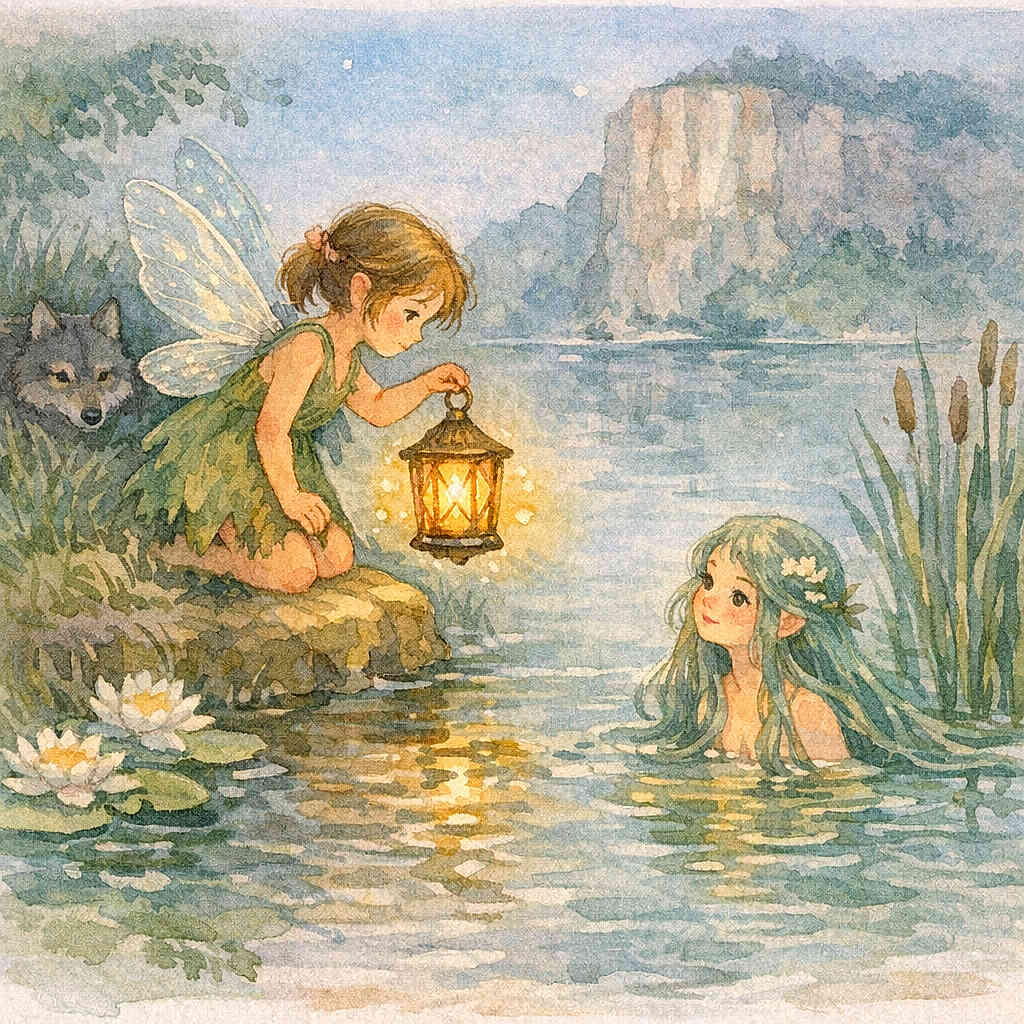
Mortal Instruments was a fairy, which was already unusual, because most fairies in Willowmere liked to be called things like Petal or Glimmer or Very Important Sparkle. Mortal Instruments didn’t mind the strange name. It had been stitched into the collar of her traveling cloak in neat silver thread, a gift from her guardian who said, “Names can be tools. Tools can build a life.”
She lived near a lake that changed its moods the way a person changes their mind. Some mornings it was flat and bright as polished glass. Some evenings it ruffled into dark folds like a blanket pulled too quickly. The townspeople called it Latchwater, because it seemed to lock secrets under its surface, and because once you started staring into it, it was hard to look away.
Mortal Instruments wasn’t the loudest fairy, or the fastest, or the one who could juggle fireflies in perfect spirals. She was careful. She listened first. She was the kind of brave that doesn’t shout; it tightens its laces, checks the map twice, and still goes.
On the day the story truly began, she was sitting on a smooth stone at the lake’s edge, polishing a tiny set of tools she kept in a walnut-shell case: a needle made from a thistle spine, a thread spool cut from reed-stem, a miniature hammer carved from driftwood, and a silver hook no bigger than a fingernail.
She used them for fixing small things: a torn wing-strap, a cracked acorn cup, a loose button on someone’s coat. The lake wind smelled of wet leaves and something faintly metallic, like rain that hadn’t decided to fall yet.
“Careful fairy,” a voice sang from the reeds.
The water near the shore stirred as if someone had lifted a curtain underneath it. A Water Nymph rose, not dripping exactly, but shining as though she had borrowed the lake’s color and returned it brighter. Her hair streamed around her like rivergrass, and her eyes were the green-gray of stones you find at the bottom of clear water.
Mortal Instruments smiled, half relieved and half wary. The nymph, called Lyr, had a habit of arriving when you thought you were alone.
“I’m not careful,” Mortal Instruments said. “I’m prepared.”
Lyr leaned her elbows on the surface of the lake as if it were a table. “Prepared for what? A button emergency? A dramatic hat collapse?”
“Don’t underestimate hats,” Mortal Instruments said, clicking her walnut-shell case shut. “They hold important thoughts in.”
Lyr made a sound that was almost a laugh, almost a bubble. “Then you should prepare for this: something is wrong with Latchwater.”
Mortal Instruments’s wings paused mid-fold. The lake in front of her had always sounded like a soft, steady voice. Today the water’s whisper was thin, as if the lake were trying to speak through clenched teeth.
“What kind of wrong?” she asked.
“The kind you can taste,” Lyr said. “The lake’s currents are dragging in circles. Fish are swimming as if they’ve forgotten where home is. And the moon-reflection…” She hesitated, a rare thing for a nymph. “The moon-reflection is missing. At night the water should hold a bright path, but now it’s just… dark.”
Mortal Instruments turned and looked across the lake. The far shore was a line of black pines, and above them the sky was still blue, late afternoon. Nothing looked broken. Yet she believed Lyr. Water nymphs were not known for dramatic exaggeration. If Lyr said a reflection was missing, then something had stolen it.
“Missing things can usually be found,” Mortal Instruments said. “But reflections don’t have pockets.”
“That’s why I came to you,” Lyr replied, tilting her head. “You fix what doesn’t seem fixable.”
Mortal Instruments felt the familiar pull in her chest: the mixture of fear and responsibility that always appeared when someone asked for help. She didn’t like danger. She liked order. But she liked the lake more. It was the place she went when thoughts became too loud.
“Show me,” she said.
Lyr slipped under the surface and reappeared farther out, gesturing with a swirl of her hand. Mortal Instruments followed along the stones and shallow water, stepping carefully so her boots didn’t sink into mud. As they moved, the air cooled. The lake’s smell sharpened.
They reached a cove where the reeds grew thick and tall. Here, the water should have been clear enough to see pebbles. Today it looked cloudy, like someone had stirred milk into it.
Lyr whispered, “Listen.”
Mortal Instruments held still. At first she heard only the wind. Then, faintly, a scraping sound, like claws on bark.
“That’s not a fish,” she murmured.
Lyr’s face tightened. “I think something is prowling the shore at night. I feel it in the ripples.”
Mortal Instruments crouched and pressed her fingers to the water. A cold shiver traveled up her arm. Not the lake’s normal chill—this was like touching a stone that had been left in the dark too long.
“A curse?” she asked.
Lyr looked away. “A kind of knot. Something tied the lake’s reflection to the bottom, like a weight. It’s not just missing. It’s trapped.”
Mortal Instruments opened her walnut-shell case and took out the silver hook. The hook was her favorite tool, because it could catch things you couldn’t hold: loose threads of magic, stray feelings, the edge of a hidden latch.
“I can try to pull on the knot,” she said. “But I’ll need to know what I’m pulling.”
Lyr nodded. “Then we go to the Deep Shelf.”
Mortal Instruments swallowed. The Deep Shelf was an underwater ledge where the lake suddenly dropped into a steep, shadowy basin. Even the bravest swimmers avoided it. Stories said old objects sank there: broken oars, lost rings, forgotten promises.
“And if we find the knot?” Mortal Instruments asked.
“Then we untie it,” Lyr said simply.
It sounded simple the way “climb the mountain” sounds simple when you say it sitting in a warm kitchen.
They traveled along the shore until the sun began to lean toward evening. Mortals—real mortals, the kind who walked on two legs and worried about homework—were not allowed this close to the fairy paths, so the woods were quiet. Yet the scratching sound returned every so often, always behind them.
Mortal Instruments tried not to glance over her shoulder too much. She didn’t want to give fear a chair at the table.
At last they reached a rocky outcrop that jutted into the lake. The water here was darker, not because of depth alone but because the light seemed reluctant to touch it.
Lyr hovered at the edge. “This is the place. Hold your breath when you go down. Not because you’ll drown—fairies don’t drown easily—but because the lake’s darkness will try to slip inside your thoughts if you inhale too deep.”
“That’s a horrible travel tip,” Mortal Instruments said.
“It’s accurate,” Lyr replied, then softened. “Stay close to me. If you feel your mind drifting, squeeze my hand.”
Mortal Instruments nodded. She tucked the walnut-shell case into her belt, looped a thin cord around her wrist, and attached the silver hook to it like a tiny grappling tool. Then she stepped into the lake.
The water welcomed her at first, cool and smooth. Her wings folded tight against her back as she sank. Light rippled above like a ceiling of shifting glass. Lyr swam beside her, moving with effortless grace.
As they went deeper, the temperature dropped. Mortal Instruments felt the lake’s silence press against her ears. Her thoughts became louder: what if the knot is too strong, what if we can’t untie it, what if the scratching belongs to something that likes fairies.
She held her breath.
The Deep Shelf appeared as a sudden flat ledge of stone, like the edge of a giant step. Beyond it, the lake fell away into black water.
On the ledge lay a scatter of lost things: a bent metal spoon, a child’s marble, a ribbon, a cracked lens from someone’s spectacles. Mortal Instruments’s curiosity tugged at her, but Lyr pointed toward the drop.
There, tethered to a rock, was something that looked like a strip of night sky caught underwater. It shimmered with pale silver, trembling as if trying to rise.
“The moon-reflection,” Lyr mouthed, though her words became bubbles.
Mortal Instruments swam closer. A thick cord of dark, fibrous material bound the reflection to the rock. It wasn’t rope. It looked like shadow twisted into braid.
Mortal Instruments reached for it with the silver hook.
The moment the hook touched the braid, the water around them trembled. A pulse traveled through the lake like a drumbeat.
From above, from the shallows, came a muffled, distant howl.
Mortal Instruments’s heart lurched. Even underwater, the sound carried.
Lyr’s eyes widened. She grabbed Mortal Instruments’s wrist and shook her head sharply, warning: not yet.
But it was too late. The braid tightened, as if it felt the hook and decided to bite back. Mortal Instruments’s wrist was yanked forward. The cord around her wrist snapped taut.
She kicked hard, trying to pull free, but the braid clung to the hook like tar.
Lyr rushed in and braced herself against the rock, pulling with both hands. For a moment, it was a silent tug-of-war: fairy and nymph against a knot of shadow.
Then, from the dark basin beyond the shelf, something moved.
It wasn’t a monster made of teeth and slime. It was worse because it was familiar: a Wolf, its form made of deeper darkness than the water. Its eyes gleamed pale, like two pieces of moonlight stolen and sharpened.
The Wolf’s body drifted as if it were swimming without moving its legs. Its fur rippled like smoke.
Mortal Instruments felt the pressure of its attention. A thought slid into her mind, cold and confident: Mine.
She squeezed Lyr’s hand, just as Lyr had instructed.
Lyr’s face tightened with determination. She thrust one palm out toward the Wolf and a bright current swirled, pushing water like a shield. The Wolf halted, but it didn’t retreat. It circled, patient.
Mortal Instruments forced herself to think like a fixer. If the hook is stuck, don’t yank. Find the latch. Find the weakness.
She looked closely at the shadow braid. It wasn’t one strand; it was many, twisted together. And woven through it were tiny flecks of something—bits of old metal, maybe, or dark pebbles.
The Wolf came closer, testing Lyr’s shield with a slow push. Lyr’s light current shuddered.
Mortal Instruments had an idea that felt risky and slightly ridiculous. She rummaged in her belt pouch and pulled out her thistle-needle and reed-thread spool.
Underwater, sewing was not easy. But she didn’t need neat stitches. She needed leverage.
She looped the thread around the shadow braid near the rock and tied it to a jagged stone edge, creating a little anchor. Then she used the hook to snag a different strand of the braid—one that looked slightly looser.
The Wolf opened its mouth. Bubbles fled from it like startled insects, and the water around its jaws turned colder.
Lyr’s shield flickered.
Mortal Instruments braced her boots on the ledge, pulled the hook sideways instead of up, and felt—yes—something give. Not the whole knot, but one strand sliding free.
The braid wasn’t a single spell. It was a woven trap. Untie one thread at a time.
The Wolf lunged.
Lyr threw herself between it and Mortal Instruments, her hair flaring like kelp in a storm. The Wolf snapped at her light current, and the shield shattered into sparks that hissed into the water.
Mortal Instruments’s stomach turned. She could not fight a Wolf made of night. She could barely fight her own worry.
But she could do something else.
She tugged on the loosened strand and it slipped out with a long, shivery release. The moon-reflection brightened, as if it had been able to inhale.
The Wolf recoiled, eyes narrowing.
Mortal Instruments understood then: the Wolf wasn’t only guarding the knot. It was feeding on the lake’s trapped reflection, drinking the quiet silver that should have belonged to everyone.
She yanked another strand free.
The reflection flared brighter. The water around them warmed by a fraction.
The Wolf snarled—no sound, only vibration—and swept its dark tail. The ledge shook. Lost objects rolled toward the drop.
Lyr grabbed Mortal Instruments’s shoulder and pointed upward. Her eyes said: now, we go.
Mortal Instruments nodded. She didn’t want to abandon the reflection, but if they stayed, the Wolf would tear them apart.
She snapped the hook free, leaving the thread anchor tied to the braid. “We’ll come back,” she mouthed at the reflection, as if it could hear.
They kicked upward, fast.
Breaking the surface felt like waking from a heavy dream. Mortal Instruments gulped air, grateful for the simple kindness of breathing.
But the shore was not safe.
On the rocks, a real Wolf stood—fur and muscle, not smoke—watching them with yellow eyes. It was large, ribs faintly visible, as if hunger had carved it from the inside. Its ears were pricked forward.
For a moment Mortal Instruments thought the underwater Wolf and this one were the same. Then she realized something more unsettling: perhaps there were two wolves, or one wolf with two faces.
Lyr hissed softly. “It followed.”
The Wolf stepped closer, paws silent on stone.
Mortal Instruments’s hands shook. She was a fairy with tools, not a warrior with a spear. She could fly, yes, but Lyr could not leave the lake far, and the Wolf was between them and the forest path.
The Wolf’s lips curled back. Yet instead of leaping, it spoke—rough, like gravel in a stream.
“Stop pulling at what you don’t own,” it growled.
Mortal Instruments blinked. “The lake doesn’t belong to you.”
The Wolf’s gaze flicked to Lyr. “It belongs to hunger. To winter. To the deep. I’m only the mouth.”
Lyr lifted her chin. “Then close your mouth somewhere else.”
The Wolf’s laugh was sharp. “If the moon returns to the water, the old boundary returns too. And then I can’t cross.”
Mortal Instruments understood. The missing moon-reflection wasn’t just pretty. It was a lock, a silver bar across a door. Without it, the Wolf could roam the shore.
“So you trapped it,” Mortal Instruments said.
The Wolf lowered its head. “I tied it down. I needed the lake quiet. I needed the nights to be mine.”
Mortal Instruments’s fear hardened into something steadier. Anger, maybe. Not wild anger, but the kind that says: you do not get to steal everyone’s light.
“We’re putting it back,” she said.
The Wolf crouched.
Mortal Instruments did the first clever thing that came to her, which was not heroic-looking but effective: she snapped open her walnut-shell case and tossed the tiny driftwood hammer into the air.
The Wolf’s eyes followed it, instinctively.
“Now!” Mortal Instruments shouted.
Lyr whipped a wave up from the lake—more splash than spell, but strong enough to strike the Wolf’s chest. The Wolf stumbled backward, startled.
Mortal Instruments grabbed Lyr’s hand and pulled her sideways along the rock, toward a narrow gap between two boulders. It was too tight for the Wolf’s shoulders.
They squeezed through. Mortal Instruments’s cloak snagged, and she yanked it free, leaving a strip of fabric behind like a sacrificed flag.
On the other side, they ran along a hidden deer trail that paralleled the shore. The Wolf’s growl echoed as it circled, trying to find a way around.
They didn’t stop until they reached a small inlet where the water was shallow and the reeds formed a natural curtain.
Mortal Instruments bent over, hands on knees, breathing hard. “Okay,” she panted. “New plan.”
Lyr’s cheeks were flushed with effort. “The plan cannot be ‘throw tools and hope.’”
“It worked once,” Mortal Instruments said, then sobered. “We need to finish untying the knot. But if the Wolf keeps guarding the Deep Shelf, it will—”
“—try to bite us,” Lyr finished. “Yes.”
Mortal Instruments stared at her walnut-shell case. Inside, besides tools, she kept small bits she’d collected: a smooth pebble, a piece of mirror, a tiny cork, a copper ring. Fixers always saved odd parts, because sometimes the missing piece in your hand matched a missing piece in the world.
She picked up the cracked mirror shard. It caught the late sunlight and threw it into her eyes.
“A reflection,” she murmured.
Lyr watched her. “What are you thinking?”
Mortal Instruments held the mirror shard up. “If the moon-reflection is a lock, maybe we can make a temporary key. Something bright enough to make the Wolf hesitate. Something that reminds the lake what it’s supposed to hold.”
Lyr’s eyebrows rose. “You want to trick the lake?”
“Not trick. Remind.” Mortal Instruments touched the mirror’s edge. “We can’t lift the whole curse at once. But we can create a burst of reflection strong enough to weaken the knot.”
Lyr looked uncertain. “How?”
Mortal Instruments began to pace, wings twitching with thought. “The mirror shard is small. But if we had more reflective pieces… like the objects on the Deep Shelf. A lens, a spoon, the marble. If we collect them and arrange them—like a mosaic—then at night we can capture moonlight and send it down.”
Lyr’s expression brightened, the way water brightens when clouds part. “A lantern, but made of reflections.”
“Exactly,” Mortal Instruments said, feeling a spark of excitement that pushed back fear. “A Reflection Lantern. We build it on the shore, and when the moon rises, we aim it into the Deep Shelf. The knot will loosen, because it can’t hold what is already shining.”
Lyr’s smile turned mischievous. “And if the Wolf comes to stop us?”
Mortal Instruments glanced toward the woods. “Then we need a distraction. Something the Wolf can’t ignore.”
Lyr tilted her head, waiting.
Mortal Instruments sighed. “Okay, it sounds silly. But wolves follow scents. If we lure it away with something it wants, we can work.”
Lyr crossed her arms. “And what does a curse-wolf want?”
Mortal Instruments thought of the Wolf’s words: I’m only the mouth. Hunger.
“Food,” she said. “Not fish. Not rabbits. Something colder. Something like… stored winter.”
Lyr blinked. “Stored winter?”
Mortal Instruments pointed to the shade beneath the reeds where the water stayed cool even on warm days. “There’s a place near the north bank where the lake keeps ice under stones, even in summer. I’ve seen it. A pocket of old cold. If we bring that cold out—just a little—the Wolf might chase it.”
Lyr looked impressed and alarmed at the same time. “You have the most unsettling ideas.”
“Thank you,” Mortal Instruments said, because she didn’t know what else to do with that.
They spent the rest of the afternoon gathering materials. Lyr dove and returned with objects from the shallows: a tarnished spoon, the cracked lens, a flat piece of metal shaped like a small plate, and the lost marble, which glowed faintly blue as if it had swallowed a piece of sky.
Mortal Instruments found driftwood and braided reeds into a frame. She worked with quick, practiced fingers, tying knots that held even when wet. She set the mirror shard and lens into the frame, securing them with reed-thread and tiny pins made from thorns.
As she built, she talked—not because she liked speeches, but because it helped her steady her mind.
“When I was younger,” she told Lyr, “I thought magic was just big, dramatic things. Lightning, fireworks, everyone cheering. But fixing taught me something else. Magic is also alignment. Getting small pieces to face the same direction. Then light knows where to go.”
Lyr watched the growing frame. “You’re not just a fairy,” she said quietly. “You’re a maker.”
Mortal Instruments paused. Compliments made her uncomfortable, like wearing shoes on the wrong feet. “I’m… a fairy,” she insisted.
“A maker fairy,” Lyr corrected, as if it mattered greatly.
When twilight arrived, they carried the half-finished Reflection Lantern to a flat stone near the Deep Shelf outcrop. The lake’s surface darkened, and the first stars blinked awake.
Somewhere in the woods, the Wolf howled, closer than Mortal Instruments liked.
Lyr touched the lake and murmured. The water rose in a smooth arc, forming a low wall around their work area. Not tall enough to stop a wolf, but high enough to slow it.
Mortal Instruments added the final pieces: the spoon as a curved reflector, the metal plate as a backing, the marble in the center like a heart.
It wasn’t beautiful in the way of palace treasures. It was beautiful in the way of clever hands: patched, purposeful, stubborn.
The moon lifted above the pines, pale and round.
Mortal Instruments adjusted the frame so the moonlight struck the mirror shard. A beam bounced to the lens, then split into a brighter, sharper line that pointed down into the lake.
The water beneath the beam shimmered.
Lyr’s breath caught. “It’s working.”
Mortal Instruments tied the frame to a stone so it wouldn’t shift. Then she slipped the silver hook onto her wrist cord again.
“Time to go back down,” she said.
Lyr nodded. “I’ll keep the beam steady.”
Mortal Instruments dove.
The lake was darker now, but the Reflection Lantern created a glowing path, a spear of moonlight cutting into the depths. Mortal Instruments followed it like a guide rope.
At the Deep Shelf, the moon-reflection pulsed, brighter than before. The shadow braid looked thinner, frayed at the edges where light had touched it.
Mortal Instruments hooked one strand and pulled sideways, like before.
This time the strand snapped free quickly, dissolving into dark flecks that floated away like ash.
Yes.
She tugged another.
Above, she felt a vibration through the water—a thud, then another. The Wolf on shore.
Her time was short.
She worked faster, unweaving the braid: hook, pull, release. Each strand came apart more easily, as if the light had weakened the knot’s stubbornness.
Then the water around her turned suddenly colder.
Mortal Instruments froze.
The shadow Wolf rose from the basin, eyes blazing with stolen silver. It moved faster than before, anger sharpening it.
Mortal Instruments’s breath threatened to burst out. She clenched her mouth shut and focused.
One last thick strand held the reflection.
The Wolf lunged.
Mortal Instruments did not try to flee. She did the thing fixers do when the last screw won’t budge: she changed the angle.
She looped her reed-thread around the final strand, threaded it through the silver hook, and pulled—using the hook not as a catcher but as a lever.
The strand stretched, resisted, then tore with a silent snap.
The moon-reflection surged upward like a freed banner. Light spilled across the shelf, washing the lost objects in silver.
The shadow Wolf shrieked—not sound, but a wave of cold panic. It recoiled, its form thinning as if the light were unmaking it.
Mortal Instruments kicked upward, following the rising reflection. The water brightened around her, and for the first time in days, the lake seemed to breathe.
She broke the surface.
On shore, the real Wolf was there, but it looked smaller now, less like a ruler and more like a starving animal caught doing something shameful.
The Reflection Lantern still beamed. The lake’s surface now held a clear, shining moon path, stretching from shore to shore.
The Wolf snarled and tried to step forward, but its paws halted at the edge of the moon path as if an invisible line burned.
It backed up, shaking its head.
Lyr rose from the water beside Mortal Instruments, dripping silver. “The boundary is back,” she said, voice trembling with relief.
The Wolf glared at them. “You think you’ve won,” it growled. “Hunger always returns.”
Mortal Instruments, still catching her breath, met its gaze. “Then we’ll feed the lake what it needs,” she said, surprising herself. “Not you.”
The Wolf’s ears flattened. It turned and trotted into the trees, disappearing into shadow, but its retreat felt less like a promise of doom and more like a door finally shut.
For a long moment, Mortal Instruments and Lyr simply watched the moonlight on the water.
Then Lyr laughed, bright and amazed. “You did it. You actually did it.”
Mortal Instruments’s knees wobbled, and she sat on the rock before she fell. “We did it,” she corrected.
The lake made a sound like a sigh, and a gentle current swirled near the shore.
Something bobbed to the surface, nudged forward as if offered.
Mortal Instruments leaned in. A small chest floated there, no bigger than a loaf of bread, made of dark wood and bound with silver bands. It looked old, but not decayed. Water rolled off it without soaking in.
Lyr’s eyes widened. “That was not here before.”
Mortal Instruments touched it carefully. The chest felt warm, like it had been sitting in moonlight for a long time.
“A reward?” Lyr guessed.
Mortal Instruments frowned. “Or another trap.”
The chest lid had no lock, only a simple latch. Mortal Instruments smiled despite herself.
“A latch,” she murmured. “Of course.”
She took out her silver hook and slid it under the latch. It lifted easily.
Inside lay a set of tools unlike any she’d seen: tiny instruments made of a pale metal that seemed to hum faintly. There was a compass with a needle shaped like a crescent moon, a pair of scissors that shimmered with edge-light, and a slender rod etched with swirling symbols.
Mortal Instruments picked up the rod. It was light as a reed, but it thrummed with contained power.
Lyr leaned closer. “What is it?”
Mortal Instruments turned it in her hands, reading the etched symbols the way you read a familiar handwriting.
“It’s a tuning rod,” she said slowly. “For aligning magic. For untying knots like the one we just fought.”
Lyr’s smile spread. “The lake is giving you better tools.”
Mortal Instruments felt a rush of gratitude so strong it almost hurt. Not the abstract kind, but the practical kind: a gift you can hold, use, and rely on.
She lifted the compass. The needle spun once, then pointed toward the center of the lake.
Mortal Instruments’s mouth went dry. “It’s pointing somewhere.”
Lyr’s eyes gleamed with curiosity. “The lake’s secrets.”
Mortal Instruments closed the chest gently. “Not tonight,” she said, though she couldn’t keep the excitement out of her voice. “Tonight we rest. Tomorrow we see what else the lake wants us to fix.”
Lyr nudged her shoulder with a playful splash. “Maker fairy,” she teased.
Mortal Instruments rolled her eyes, but she was smiling. The fear that had followed her all day had loosened like the last strand of shadow braid.
They sat together at the lake’s edge as the moon climbed higher, its reflection steady and bright. Somewhere far off, an owl called. The woods felt quieter, as if even the trees were relieved.
Mortal Instruments opened her walnut-shell case and placed her old tools beside the new ones, lining them up carefully.
Old and new. Small and shining. Prepared and brave.
Lyr watched her arrange them. “You know,” the nymph said, softer now, “the Wolf will try again someday.”
Mortal Instruments nodded. “Probably.”
“And you’re not frightened?”
Mortal Instruments considered the question honestly. “I am,” she admitted. “But now I know something. Fear is a knot. You don’t have to tear it apart all at once. You can find one strand and loosen it.”
Lyr’s eyes warmed. “That sounds like a lesson.”
Mortal Instruments shrugged. “It’s also a method.”
They laughed quietly.
Before they parted, Mortal Instruments tucked the new tuning rod into her belt. It fit there as if it had always belonged.
As she walked home along the moonlit path, she glanced back at the lake. The Reflection Lantern still stood on the rock, catching light and sending it where it was needed.
For the first time, Mortal Instruments didn’t just feel like someone who fixed small tears.
She felt like someone the lake itself trusted.
And in her pocket, the moon-compass tapped gently against the chest’s silver band, as if eager for the next mystery.