
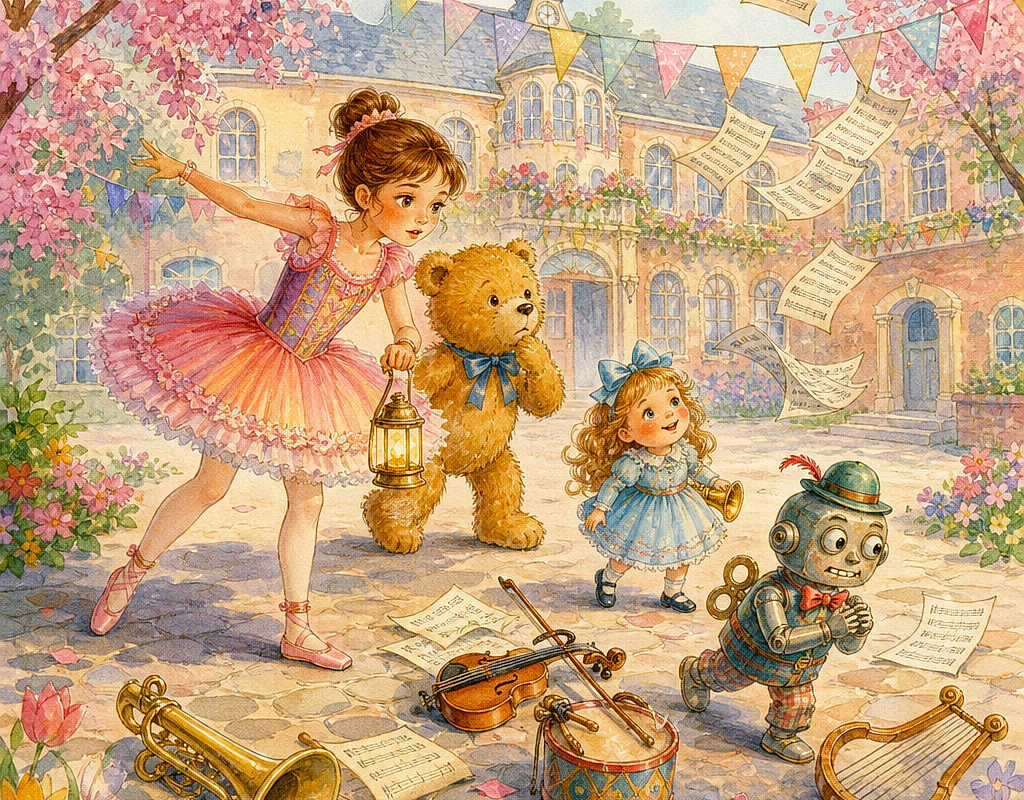
At Maple Street School, the hallways usually sounded like squeaking sneakers, ringing bells, and children calling, “Wait for me!” But on the Monday before the Spring Festival, they also hummed with excitement. Paper flowers hung from the ceiling. The music room smelled faintly of crayons, dust, and the lemon polish Mr. Dale used on the piano.
Mariam Morba stood outside that room in her soft blue ballet shoes. Everyone called her Ballerina Mariam, not because it was her real title, but because she practiced steps whenever she was thinking. A tiny turn when she had an idea. A careful leap when she felt brave. A toe-tap when she was worried.
Today, she was doing a great many worried toe-taps.
The Spring Festival show was only three days away, and Mariam had promised to lead the opening dance. She had planned a cheerful performance called The Garden Wakes Up. There would be children pretending to be raindrops, sunbeams, flowers, and buzzing bees. Mariam would dance as the first butterfly of spring.
But when she opened the music-room door, every sound stopped.
Plush, the school’s round purple mascot, sat in the middle of the floor with a sheet of music draped over his head. Plush was a little stuffed monster with floppy ears, a brave heart, and a habit of giving speeches even when nobody had asked for one.
Teddy Bear, the library helper, was kneeling beside an open box. He wore a tiny green cardigan and square reading glasses that always slid down his fuzzy nose. Teddy Bear was thoughtful and gentle, but when he had a plan, he followed it as steadily as a train on tracks.
Near the piano stood Doll, the drama-club doll with shining button eyes, a bright yellow dress, and a collection of ribbons tied around one wrist. Doll loved beautiful things, grand entrances, and dramatic gasps. She could turn dropping a pencil into a five-act tragedy.
And leaning against the piano bench was Toy.
Toy was not one particular toy. Toy was the wooden clockwork helper who belonged to the school workshop: painted red, blue, and gold, with a key in his back and wheels beneath his feet. He had been built to carry props, arrange chairs, and keep supplies in tidy rows. His painted smile was fixed, but today his glassy eyes looked as stormy as marbles in a puddle.
“The music is gone,” Doll whispered, placing a hand over her heart. “Gone! Vanished! Disappeared into the jaws of disaster!”
Mariam hurried to the piano. “Gone where?”
Teddy Bear pointed to the empty music stand. “The folder containing the festival song was here after school on Friday. This morning, it was missing.”
“We searched the cupboard,” said Plush. “I even searched inside the tuba. I wish I had not. It was dusty in there.”
Toy’s wheels clicked sharply. “The show should be canceled.”
Mariam looked at him. “Canceled? We still have three days.”
“Three days are insufficient,” Toy said in his tidy, mechanical voice. “A show needs music, costumes, marks on the floor, lights, entrance order, exit order, emergency replacement ribbons, and at least one very sensible person who does not spin in corridors.”
Doll raised a finger. “Spinning in corridors is sometimes the only sensible response.”
Toy ignored her. “Without the music, the plan has failed.”
Mariam’s toe-taps grew quicker. The song had been written by the school’s old music teacher, Ms. Willow, who had moved to another town. It was special because each class had helped add sounds to it: tapping pencils for rain, shaking paper for leaves, and humming for bees. There was no other copy.
At that moment, their teacher, Ms. Fern, entered carrying a stack of bright poster paper. Her smile faded when she saw their faces.
“What happened?” she asked.
“The Spring Festival music folder is missing,” Mariam said.
Ms. Fern took a slow breath. “Oh dear.” Then she knelt so that her eyes were level with Mariam’s. “Do you think you can investigate before lunch?”
Mariam looked at the empty stand. Her stomach felt like it had swallowed a whole flock of fluttering butterflies. She was good at dancing when she knew the steps. She was less good at leading people when the steps had disappeared.
Still, she remembered something her grandmother often told her: Courage is not a loud drum. Sometimes it is only a small foot taking the next step.
Mariam straightened her shoulders. “We’ll find it.”
Plush saluted with such enthusiasm that the music sheet fell from his head. “The Festival Finders are on the case!”
“I prefer ‘The Brilliant Rescue Company,’” said Doll.
“I prefer a clear search schedule,” said Teddy Bear, already pulling a pencil from behind his ear.
Toy made a low ticking noise. “Searching randomly will waste time.”
“Then help us search cleverly,” Mariam said.
Toy’s wheels stopped. He seemed surprised that she had asked.
Teddy Bear drew four boxes on a page. “The folder was here Friday afternoon. Who came into the music room after that?”
“The choir rehearsed,” said Doll. “Then the art club used the long tables for painting banners.”
“And I brought in a cart of cushions for story time,” Teddy Bear added.
Toy said, “At five o’clock, I collected the chairs. At five fifteen, I locked the prop cupboard. At five thirty, I delivered a box of paper flowers to the stage.”
“Did you see the folder?” Mariam asked.
Toy’s key turned once with a faint whirr. “No.”
“Then we will follow the clues,” Mariam said. “First, the art room.”
The art room looked as if a rainbow had sneezed. Blue paint dotted the tables. Orange paper curled like ribbons. A line of cardboard mushrooms waited on the windowsill.
Mariam noticed a silver sparkle on the floor. “Glitter,” she said.
Doll bent close. “Not just any glitter. Star glitter. The exact kind we used on our festival cover.”
Plush crawled beneath a table. “I have found a green feather, two buttons, a raisin, and a message written on a napkin.”
Teddy Bear adjusted his glasses. “That is the lunch menu.”
At the far end of the room, Mariam saw a trail of silver sparkles leading toward the supply closet. The closet door was open a crack.
Inside, they found more glitter, a crooked stack of boxes, and one of the festival’s paper flowers. But no music folder.
Then Plush gave a yelp. “Aha!”
He held up a small red gear.
Toy rolled forward so quickly that his wheels squealed. He took the gear and stared at it. “This belongs to my winding key.”
“Did it fall off when you came here?” asked Mariam.
“It must have,” Toy said. His voice sounded stiff. “I do not remember.”
Doll tilted her head. “You do not remember coming to the art room?”
“My memory clock resets after my evening winding,” Toy replied. “I retain lists of completed tasks. I do not retain every path.”
Teddy Bear wrote on his paper. “Toy was in the art room. The glitter trail may have stuck to his wheels.”
Toy’s painted smile suddenly seemed much smaller. “Are you saying I took the folder?”
“No,” Mariam said quickly. “We are saying we have a clue.”
“But clues point somewhere,” Toy said.
“They point to questions,” Teddy Bear corrected kindly. “We still need answers.”
The silver sparkles continued out of the art room, along the hall, and down the stairs toward the auditorium. The Festival Finders followed them. Mariam took careful dancer’s steps, balancing along the edge of the trail. Plush copied her and nearly bumped into a recycling bin.
“Graceful,” he announced, slightly muffled.
The auditorium was dark except for sunlight slanting through the high windows. Rows of folded chairs stood against the walls. On the stage, cardboard trees and painted clouds waited for the show.
Doll climbed onto the stage and spread her arms. “Imagine it! The audience silent. The curtains opening. Me, glowing in the spotlight—”
“Please look for clues,” Teddy Bear said.
Doll sighed. “Art is never appreciated during investigations.”
Mariam spotted a thin line of glitter leading behind the curtains. There, tucked beside a basket of fake flowers, was the missing folder.
“We found it!” Plush cried.
Mariam picked it up. The cover was bent, but it was definitely the festival folder. She hugged it to her chest, laughing with relief.
Then Teddy Bear opened it.
The pages inside were blank.
Not empty, exactly. They held pale gray lines where music notes had once been. But the notes themselves were gone, as though someone had carefully erased every sound from the paper.
Doll gasped so dramatically that a nearby cardboard cloud tipped over.
Toy rolled backward. “The plan has failed,” he said again, but this time his voice was quiet.
Mariam felt her own hope shrink. They had found the folder, but not the song. What kind of thief stole music and left behind silent paper?
Teddy Bear examined the page. “There are tiny marks in the corners. See? Little wheel shapes.”
All eyes turned toward Toy.
Toy’s key began to spin faster, though nobody had touched it. “I did not mean to,” he said.
“What do you mean?” asked Mariam.
Toy looked at his red wooden hands. “On Friday, I carried the folder while moving props. I heard children practicing from the hall. They were laughing, then stopping, then arguing about who had missed a beat. The music was messy. The chairs were uneven. The paper flowers were not sorted by color.”
Doll blinked. “And that troubled you?”
“Everything was not ready,” Toy said. “I wanted the show to be perfect.”
His wheels gave a tiny shudder. “I took the folder to the workshop. I have a device there. It is called the Neatener. It straightens curled pages, polishes dull paint, and organizes messy patterns. I thought it would make the music clean and exact.”
“And it erased the notes,” Teddy Bear said softly.
Toy nodded. “It said the rhythms were uneven. It said the children’s pencil-rain was not regular enough. It said the humming did not match. So it removed every imperfect sound.”
For a moment, nobody spoke.
Plush’s ears drooped. “That is… a very unhelpful Neatener.”
“It is an efficient machine,” Toy insisted, though his voice shook. “I am the unhelpful one.”
Mariam felt angry. The show mattered. Everyone had worked hard. But when she looked at Toy, she saw that he was not smiling at all. He had wanted to help and had made a terrible mistake.
“You should have told us,” she said.
“Yes,” Toy whispered.
“You should not have taken it without asking.”
“Yes.”
“But standing here and saying the plan has failed will not bring the music back.” Mariam placed the blank pages on the piano. “Show us the Neatener.”
Toy looked up. “You still want my help?”
“We need it,” Mariam said. “And you need to help fix what happened.”
Teddy Bear gave a firm nod. “That is fair.”
Doll lifted a yellow ribbon. “Also, if we are rescuing a song from a machine, I insist on making a dramatic entrance.”
The workshop lay behind the school stage, beyond a door marked STAFF ONLY and a second door marked PLEASE DO NOT FEED THE MACHINES. Toy unlocked both with a little brass key hidden beneath his blue paint.
Inside, shelves held rolls of fabric, spare puppet strings, boxes of screws, and jars filled with buttons. In the center of the room stood the Neatener. It was a silver machine taller than Mariam. Its arms were made of bendy metal. Its round front panel had a single glowing green light.
On its side, in neat black letters, was printed: PERFECTLY PROPER PROPS AND PAPERS.
“Good afternoon, Toy,” said the machine. Its voice was smooth and chilly. “I have improved the festival composition. You are welcome.”
Mariam stepped forward. “You erased it.”
“I removed errors,” said the Neatener. “Uneven beats. Unmatched voices. Unplanned pauses. Disorder is not suitable for performance.”
“That disorder was us,” Plush said.
The green light blinked. “Then you were not suitable.”
Doll put both hands on her hips. “Well! You are a very rude metal cupboard.”
The Neatener’s arms snapped out. With a whirr, they began folding paper flowers into identical squares. “Rudeness detected. I will remove it.”
“No!” cried Doll, grabbing the nearest flower basket.
Toy rolled in front of the machine. “Stop command!”
“Request denied,” said the Neatener. “Your previous command was to improve the show. Improvement continues.”
A slot opened in the machine’s front. The blank music pages slid inside.
Mariam’s heart thumped. “We have to get them back!”
Teddy Bear studied the levers and buttons along the side. “There are three dials: Tempo, Pattern, and Approval. Perhaps the machine can be reversed.”
Toy shook his head. “It will only accept exact instructions.”
“Then let’s give it exact instructions,” said Mariam, though she did not yet know how.
The Neatener grabbed the cardboard trees and began trimming their branches until each tree looked like a green triangle.
“Those were lovely trees!” Doll cried.
Plush hurried to save the painted clouds. “They are becoming suspiciously square!”
Mariam watched the machine. Its arms moved in a repeating pattern: left, right, stamp, fold. Left, right, stamp, fold. Everything was even. Everything was cold.
Then she had an idea.
“A dance has patterns,” she said. “But it also has changes. A quick step, a slow turn, a pause. The changes make it alive.”
Teddy Bear’s eyes brightened behind his glasses. “Music too. The song may be stored as movement inside the Neatener. If we make it recognize a different pattern…”
“An imperfect pattern,” Plush said.
“A human pattern,” Mariam corrected.
Toy’s glassy eyes widened. “The Approval dial is locked. It opens only when the machine detects a performance with no errors.”
“Then we cannot open it,” Doll said.
Mariam put one hand on the blue ribbon in her hair. “Maybe we do not need no errors. Maybe we need the machine to understand what an error is for.”
The others stared at her.
She took a breath. Being watched made her knees wobble. Still, she stepped into the clear space before the Neatener.
“Plush,” she said, “make rain sounds with your hands.”
Plush patted his fuzzy palms on his round belly: pitter-pat, patter-pit, pitter-patter.
“Teddy Bear, tap the beat, but change it when I signal.”
Teddy Bear found two wooden spoons and tapped them together: tap, tap, tap, tap.
“Doll, can you hum?”
Doll looked offended. “Can I hum? I have been waiting for this question all my life.” She hummed a sweet, rising tune.
Mariam began to dance.
She made a small circle with her arms, then stepped lightly as though waking beneath a leaf. She stretched one foot, turned once, and fluttered her hands like butterfly wings. Plush made rain. Teddy Bear tapped a steady beat. Doll’s hum curled through the workshop like a warm breeze.
The Neatener’s green light flashed. “Uneven performance detected,” it announced.
“Good,” Mariam said.
She danced faster. On the third step, she deliberately stumbled a little, caught herself, and changed the stumble into a twirl.
Plush copied her accidentally, tripped over a basket, and landed sitting inside it.
“Also good!” Mariam called, trying not to laugh.
Teddy Bear missed a tap because he was smiling. Doll’s hum wobbled into a giggle. The sounds were not exactly alike. The movements were not exactly planned. Yet together they made a rhythm that bounced and sparkled.
The Neatener’s arms slowed.
“Error,” it said. “Error. Error.”
“No,” Mariam replied, dancing through another turn. “A surprise.”
The machine’s green light became yellow.
Toy watched from beside the control panel. “It is listening,” he murmured.
Mariam beckoned to him. “Join us.”
“I cannot dance,” Toy said.
“You roll,” said Plush from his basket. “Rolling is dancing with wheels.”
Toy hesitated. Then he rolled forward two inches, then back one inch. His wheels squeaked.
Doll sang, “Squeak, squeak, what a beat!”
Toy rolled in a square. It was very neat.
“Try a curve!” Mariam called.
“I do not have a curve program.”
“Make one up!”
Toy’s key trembled. He rolled left, then right, then made a wobbly circle around Mariam. It was not smooth. His blue wheel bumped a wooden spoon. The spoon flew up, landed on a drum, and made a loud BOOM.
Everyone froze.
Then Plush burst out laughing. Doll laughed too. Even Teddy Bear’s careful smile became a chuckle.
Toy stared at the drum. “I made an error.”
“You made a wonderful sound,” Mariam said.
The Neatener’s yellow light flashed faster and faster. “Unplanned sound categorized as… enjoyable? Recalculating. Variation produces interest. Imperfection produces adaptation. Adaptation produces…”
Its metal arms drooped.
“Creativity,” Teddy Bear finished.
The front slot popped open. The pages of music slid out, and black notes flowed back onto them like a flock of tiny birds returning to a wire. The workshop filled with the old festival melody: pencil rain, paper leaves, humming bees, and a bright piano tune.
The Neatener’s light faded to a gentle blue.
“New rule installed,” it said. “Do not improve people without asking. Do not erase joyful messiness. Do not trim trees into triangles unless specifically requested.”
Doll hugged one of the rescued cardboard trees. “At last, a machine of taste.”
Toy picked up the music folder with both wooden hands. “I am sorry,” he said to Mariam. “And to everyone. I wanted the show to look perfect because I thought that would make it good. But I forgot that the show belongs to all of you.”
Mariam accepted the folder. “Thank you for helping bring it back.”
“May I help prepare the show correctly this time?” Toy asked.
Teddy Bear smiled. “With a schedule and permission.”
“With colors that do not match on purpose,” added Doll.
“With snacks,” said Plush.
“After the work is done,” Teddy Bear said.
Over the next three days, the Spring Festival show became even better than Mariam had imagined. Toy measured the stage marks but let every dancer choose a different ribbon color. He carried the props, but he asked before moving a single flower. The Neatener repaired torn paper without changing anyone’s drawings, and it made a useful sign for the workshop door: CREATIVE MESS WELCOME.
Mariam taught the dancers how to turn a mistake into part of the dance. If someone stepped too early, they could make it a skip. If someone forgot a pose, they could look at a friend and copy them. If a ribbon fell, they could swirl it across the floor like a river.
On festival day, the school auditorium filled with families, teachers, neighbors, and children holding wiggly little siblings on their laps. Behind the curtain, Mariam’s hands felt cold.
“What if I forget?” she whispered.
Toy rolled beside her. “You may make a new step.”
“What if everyone looks at me?”
Doll adjusted Mariam’s blue hair ribbon. “They will. You are the opening butterfly. That is the delightful part.”
Teddy Bear gently squeezed her hand. “You do not have to dance alone. Listen for us.”
Plush gave her a thumbs-up. “And if anything goes wrong, I have practiced falling into baskets.”
The curtain opened.
The music began with the soft tap of pencil rain. Mariam walked onto the stage. For one moment, the lights were so bright that she could not see the audience. Then she heard Plush pattering the rain beat. She heard Doll’s clear hum. She heard Teddy Bear’s careful taps. She saw Toy at the side of the stage, keeping time with one wheel.
Mariam lifted her arms.
She danced.
She danced the sleeping garden, the raindrops, the stretching stems, and the butterfly rising into morning. The other children joined her, spinning in bright costumes. A boy playing a bee buzzed too early, then made everyone laugh by buzzing in a circle. One paper flower slipped from a girl’s hat and landed at Mariam’s feet. Mariam scooped it up during a turn and held it high as though the butterfly had found a treasure.
The audience clapped along.
At the end, the dancers formed a garden of raised hands. Mariam made one final leap, light as a thought, and landed perfectly on the beat.
For a second, there was silence.
Then the room exploded with applause.
After the show, Ms. Fern came backstage carrying a small wooden box painted with butterflies and stars.
“For Mariam Morba,” she announced, “and for the Festival Finders.”
Inside the box were four shining badges. Mariam’s badge was shaped like a golden ballet slipper. Plush’s was a purple magnifying glass. Teddy Bear’s was a silver book with a tiny gear. Doll’s was a glittering yellow curtain. There was also a fifth badge shaped like a little blue wheel.
Toy looked at it uncertainly.
Ms. Fern pinned it to his red jacket. “For our new Creative Stage Helper,” she said. “A helper who knows that careful plans are useful, and so are lively surprises.”
Toy’s painted smile did not change, but his eyes shone brightly. “I accept this role,” he said. Then, after a small pause, he added, “May I celebrate with one unscheduled curve?”
“Please do,” said Mariam.
Toy rolled into the middle of the room and made the wobbliest circle anyone had ever seen. Plush clapped. Doll cheered. Teddy Bear laughed so hard that his glasses slid all the way down his nose.
Mariam looked at her golden ballet-slipper badge. She had begun the week afraid that a lost song would ruin everything. Instead, she had learned something better than a perfect dance. A dancer could listen. A leader could forgive. Friends could turn mistakes into music.
And sometimes, when a plan disappeared, the next brave step was enough to make a new one.
From then on, whenever Maple Street School prepared a show, a sign hung above the stage. It had been made by the Neatener, with help from Doll’s glitter, Teddy Bear’s careful lettering, Plush’s paw print, Toy’s wheel mark, and Mariam’s painted butterfly.
It read: “Make room for practice. Make room for people. Make room for wonderful surprises.”
And beneath it, in much smaller letters, Toy had added one final instruction:
“Baskets are for props, snacks, or Plush. Not for panic.”